Showing posts with label author interview. Show all posts

Blog Tour: Tonight the Streets Are Ours by Leila Sales

Sunday, September 13, 2015


Today, I'm more than thrilled to highlight an absolutely amazing contemporary by one of my favorite authors, Leila Sales. Tonight the Streets are Ours is the story of Arden Huntley, a "recklessly loyal" girl who decides to road trip to find her favorite blogger when he posts about his break-up. What follows is surprising and true, but we'll expound on that in tomorrow's review. Today, in honor of the book's release and September 19th's hashtag event, #tonightthestreetsareours, we'll be switching up the usual blog tour format. Instead of talking to Leila, she'd like me to answer her questions about being a blogger.

Photo credit: Franck Goldberg
Leila: What's the hardest part about being a blogger?


Danielle: Time. 

I work 60+ hours a week at my day job and I have an apartment, a husband, and a cat that all require some sort of daily attention. (Rude, right?) I read a book every other day, which means about 2 hours a day of reading, and each review takes an additional 2 hours to write, format, post, and cross post to GR. I can't even begin to calculate how much time I spend networking, reading others' blogs, commenting, trying to keep up with pub news...I try to post two to three times a week, but sometimes it's all I can do to tweet a star rating. 

In TONIGHT THE STREETS ARE OURS Peter purposefully keeps his blog a secret from his friends and family so he can write whatever he wants about them. What do your friends and family think about your blog? Do they read it and comment on it?


My family is aware of the existence of my blog, but despite multiple links in all of my social media profiles, I'm not sure any of them have ever visited. Occasionally my husband and girlfriend will comment on my GR account, but they never cross over here. 

I think that's OK, though, because I've been more brutally open about my mental health issues than I think I could be if I thought they were reading.

What's your favorite comment you've ever gotten?


I don't even have to look it up; I keep it over my desk to remind me why I blog.

Dear Danielle,

There are a lot of firsts for a first-time author. In my day job as an editor, I've seen most of them. Two are pretty inevitable: the first bad review and the first good review.

I've seen most of them for the writers I've worked with, but now it's my own book out there. It's a very different thing to experience these firsts for your own work.

Thank you, Danielle, for my very first good review--hell, my very first great review. It means so much, and I don't suspect I'll ever forget it.

Sincerely,

Harrison Demchick

That came in September 26, 2012, in my first month of blogging. It was in response to my first ARC review. So you may not forget my review Mr. Demchick, and I'll never forget the day I realized bloggers make a difference.

Have you ever written a blog post that you later regretted?


Never a blog post, but I have regretted tweets. Blog posts take a lot of time to write and format, which has always given me the chance to step back. Tweets can be shot off without thought, and I have said thoughtless things in them.

(I did tell my husband I loved him for the first time in a blog post, but since that worked out, I'm not counting it.)

For how long have you been a blogger, and what inspired you to start blogging?


I've been book blogging for three years now, though I've been blogging in a lot of different iterations for more than a decade. (Reviews, creative writing, and personal blogs. Before Tumblr, before Blogger, before Livejournal and Xanga and Typepad, before Internet forums, we had a thing called Usenet that someone might, hypothetically post bad pre-teen poetry to. Please don't do the math.)

As for why blogging? Escapism, mostly, and a desire to feel heard. 

I faded out of the blogging world during/after college, but when my girlfriend went back to school, I was having trouble making new friends and I started spending a lot of time at the library. I missed talking about books with people. Then I read a book that was absolutely life changing(ly bad). I needed to tell someone, so I wrote 1400 words and stuck it up on Goodreads. Jessie, who's been with me since my Wheel of Time theory blog days, asked me to join her at Ageless Pages. It took me another 8 months before I was willing to jump in, but now I get to relax from my high stress job, make friends with whom I know I have something in common right off the bat, and talk about my absolute favorite thing with my favorite person.

Join the rest of the tour, and read everyone's answers, via these sites:

September 1- Reader of Fictions
September 3- Ticket to Anywhere
September 4- Alexa Loves Books
September 5- The Book Cellar
September 6- The Irish Banana
September 7- Adventures of a Book Junkie
September 8- Supernatural Snark
September 9- The Compulsive Reader
September 10- Miss Print
September 11- Book Rock Betty
September 12- Reading Teen
September 13- Ageless Pages Reviews
September 14- Perpetual Page Turner
September 15- Books and Whimsy
September 16- Fierce Reads


Tonight the Streets Are Ours

From the author of This Song Will Save Your Life comes a funny and relatable book about the hazards of falling for a person you haven’t met yet.

Seventeen-year-old Arden Huntley is recklessly loyal. Taking care of her loved ones is what gives Arden purpose in her life and makes her feel like she matters. But she’s tired of being loyal to people who don’t appreciate her—including her needy best friend and her absent mom.

Arden finds comfort in a blog she stumbles upon called “Tonight the Streets Are Ours,” the musings of a young New York City writer named Peter. When Peter is dumped by the girlfriend he blogs about, Arden decides to take a road trip to see him.

During one crazy night out in NYC filled with parties, dancing, and music—the type of night when anything can happen, and nearly everything does—Arden discovers that Peter isn’t exactly who she thought he was. And maybe she isn’t exactly who she thought she was, either.

Add it on Goodreads! Preorder it at Amazon, B&N, The Book Depository, or Books of Wonder.

Join in on social media with #TonightTheStreetsAreOurs.

Find Leila on her website or Twitter!

Plus, a challenge!


On Saturday, September 19, starting at sundown and going as late as you want, do something fun, make a record of it, and share it with the world. Using the hashtag #TonightTheStreetsAreOurs, instagram or tweet whatever happens in your night. If you’re going to a party, aimlessly driving around with friends, or watching a movie alone in your PJs, we want to hear about it.

Here’s why: We’re celebrating the launch of Leila Sales’s novel TONIGHT THE STREETS ARE OURS, the story of a 17-year-old girl who goes on an epic all-night road trip to NYC with her best friend in pursuit of her favorite blogger. It’s the sort of night where anything can happen, and almost everything does.

Now it’s your turn. Whatever you’re doing with your night, wherever you live, however old you are: you’re invited. Leila will be livestreaming her own nighttime adventures so you can join her remotely HERE. Or just do your own thing and post it online. We are all in this together.  #TonightTheStreetsAreOurs.
As we gear up for the big night, invite your friends, and leave a comment below with a story about some amazing night when the streets were yours. One lucky commenter on this page and three people who participate in the event on September 19 will win signed copies of the book.

Together, we will own this night.

a Rafflecopter giveaway

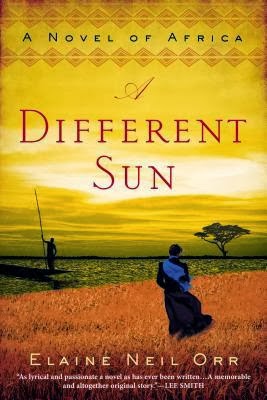
Book Tour Q&A with Elaine Neil Orr for A Different Sun

Wednesday, January 29, 2014
Elaine Neil Orr is the author of A Different Son, and Gods of Noonday (nonfiction). She stops by the blog today to talk about her newest historical fiction work.

In 1853, newly married Emma Bowman arrives in Afrida and steps into a world of unsurpassed beauty — and peril.

A page-turning adventure with life and death stakes for the body and the soul…

Born into a life of privilege in rural Georgia, Emma yearns for important work.  An ardent passion burns in her soul, spurring her beyond the narrow confines of her family’s slave-holding plantation.  She meets and weds Henry Bowman, a tremendously attractive former Texas Ranger twice her age, who has turned from the rifle to the cross.  Together with their dreams of serving God they take ship for West Africa.  Emma leaves every known thing behind, save a writing box Henry has made for her. In it she carries a red journal and an odd carving made by an old African owned by her father.

The couple’s intimate life has hardly begun when they are beset by illness, treacherous travel, an early pregnancy, a death.  Emma opens her heart to Africa, yet at every turn her faith is challenged.  In deep night, she turns to the odd carving for comfort and in snatches of calm makes record in her diary.  She redoubles her energies, even as she begins to doubt her husband’s sanity.  Yet she loves him.

When they hire Jacob, a native assistant to guide their caravan, Emma is confronted with her greatest challenge.  Henry’s health begins to fail, and she is drawn deeper into the African world.
Something is revealing itself to her.  But is it a haunting mystery from her past or a new revelation coming toward her out of this mysterious continent?

A compelling story of temptation, courage, faith, and the redemptive quality of love, both human and divine, A Different Sun will transport you to a world where tragedy and triumph lie a heartbeat away.


 Q&A with the author:


 #1. You cite the Bowens as the inspiration for this particular story -- was adapting their factual mission into fiction harder or easier than imagined?

A Different Sun is my first novel, published after writing a memoir. In a way it’s a little hard to know if writing a novel inspired by a diary is harder or easier than writing “out of thin air” so to speak. I do think that many novelists write out of an historical footnote. Toni Morrison’s Beloved was inspired by a newspaper story about a woman who killed her children rather than having them taken back in to slavery. Therese Fowler’s novel, Z: A Novel of Zelda Fitzgerald is clearly inspired by an entire life. 
For me, I suspect, especially because I was writing my first book-length fiction, it was helpful to have the inspiration. I decided early on that most of the novel would cover the three years spanned by the actual diary, while the couple is in West Africa (current day Nigeria), making their way as early explorers and missionaries in what is for them both a tantalizing and punishing land. I knew who my primary characters were: husband and wife. And I knew from the start that I wanted to offer both points of view so that readers had access to why Henry is the way he is, as well as Emma. Of course I had to make much of that up!

The really fun parts were the “making up.” While I knew their first baby died, I had no idea what inspired Emma (my character, not the historical diarist) to become a missionary. I invented Uncle Eli. But I did research in order to do so. I wanted him to be historically based and plausible. Such slave artisans did live close to the master’s house, they were given better treatment, and when there was a “problem,” they could be punished just as harshly as any enslaved person. Jacob is also my invention, the African man Emma falls in love with. Most of the novel is invention, for example, Emma beginning to change her clothes from Victorian to more open, breezy, and African. I loved creating that metaphor for her coming of age and the opening of her moral consciousness.

#2. What was the most challenging aspect of writing A Different Sun? The easiest?

Everything was the most difficult. Well, one thing was relatively easy for me: describing the countryside. I was born and grew up in Nigeria. I know the hawks, the color of the sky, the feeling of heat, the sound of lizards on dry ground, the look of palm trees near a creek bed, the smell of fires burning, and the sound of drums beating through the night. Southeastern Nigeria was my cradle.

Everything else was a steep learning curve, from the mundane—how do you get characters in and out of a room?—to the vast and ultimate—how do you keep propelling the story so that the reader wants to keep reading. I sought out good readers, novelists who had published several books, to read for me. I had wonderful feedback from wonderful writers such as Sena Jeter Naslund, author of the best-selling Ahab’s Wife and Jill McCorkle, whose wonderful latest novel, Life After Life was published this year. My advice for any beginning novelist is to find good writers to work with and read read read. Read good books all the time!

#4. Did growing up in Nigeria have an affect on how the story was written/researched?

I was drawn to the story because it was about the missionaries who founded the very mission compound I was born on one hundred years later.

And I was delighted to travel back to Nigeria three times to trace my characters’ steps.But I don’t think it affected how I did my research. I’m a trained researcher who has written two scholarly books about American women writers. I LOVE research. It’s like looking for buried treasure. You can go an inch deep and strike gold. I’m writing a second novel set in Winston-Salem, North Carolina, in the late 1950s. I’ll do research in the same way I did for A Different Sun, though at least it won’t be 1853 and I won’t have to figure out how to refer to underwear!

#5. Do you have a favorite scene from the book? As an author or as a reader?

Yes. I absolutely love the scene in which Emma draws Africa and America for the Iyalode out in the yard, using a stick. That scene came to me in a rush as I wrote. It hardly had to be revised. It’s a major turning point in the novel when Emma realizes the connection between the slave-owning South and her own mission to Nigeria.

#6. Do you see any of yourself in the characters -- Emma/Mittie Ann/Tela?

Oh yes, there’s a little of me in Emma. Though there is more of my mother, also a missionary. She, like Emma, is a pious person. She has a kind of faith I never understood but that I wanted to understand. A huge motivation for me in writing the novel was to try to understand religious faith. My part in Emma is her tomboyish girlhood, not being the pretty daughter but being the father’s companion, her determination and hard-headedness. And I’ll confess this too: falling in love with Jacob. I haven’t fallen in love with a Nigerian man (yet!) but when I visited Nigeria in 2003 for the first time in twenty years and I saw Nigerian men and how they walked—so straight and confident, in that billowing cloth—I thought: “Now there’s a man!” I suppose the image of those men from my childhood came back to me and that more flowing, powerful masculinity spoke to my core.

#7. Upon finishing your novel, what would you like readers to take away from it/think about?

What it means to live a conscious life. My entire purpose in Emma is to show the process of her coming of age, the way she comes to see her flaws even though her epiphany is painful. More than that, she comes to see that her privileged life came at a cost to someone else—to an entire sub-continent. More than any time in the history of humanity, now is the time we must acknowledge that any of us who has more than we need is probably taking from someone else who doesn’t have enough.

I just want to thank Elaine for taking the time to stop by today.

Praise for A Different Sun

Library Journal STARRED Review: Verdict Lush, evocative, breathtaking in its descriptions, and deeply spiritual in its themes of love, forgiveness, and transformation, this extraordinary novel shines with light and depth. Reminiscent of Barbara Kingsolver’s magnum opus, The Poisonwood Bible, with elements of Joseph Conrad and Louise Erdrich, Orr’s stunning debut is starkly beautiful and true to life.
“A magnificent novel that explores the charged juncture between nineteenth-century Africa and the slaveholding South. This is the spellbinding, richly imagined story. –Angela Davis-Gardner, author of Plum Wine and Butterfly’s Child

“A beautiful novel, exquisitely written, perfectly complex, true to the past, relevant today, unforgettable.” –Philip F. Deaver, author of Silent Retreats, winner of the Flannery O’Connor Award
“From frontier Georgia to tropical Africa, a dazzling tale of love, cruelty, and redemption,” –Tony Pederson, former executie editor of The Houston Chronicle

“A Cathartic Epic filled with physical and intellectual adventure bordered by psychological drama.  It is difficult to write fiction that is as fantastic as it is real.” –Linda Beattie, Louisville Courier-Journal
“As lyrical and passionate a novel as has ever been written.”  Lee Smith, NYT Best-Selling Author
“Language so fine, my breath went right out from me.”  Eleanor Morse, author of White Dog Fell from the Sky

A Different Sun is a Southern Indie Booksellers Association Best Seller.

About Elaine Neil Orr:

Elaine Orr

Elaine Neil Orr is a trans-Atlantic writer of fiction, memoir, and poetry.  Themes of home, country, and spiritual longing run through her writing.  A Different Sun: A Novel of Africa, her newest book (Berkley/Penguin, 2013), has been called by Lee Smith “as lyrical and passionate a novel as has ever been written.  [It] shines in the mind like a rare gem.”  Philip Deaver describes it as“[a] beautiful novel, exquisitely written, perfectly complex, true to the past, relevant today, unforgettable.”
 
Her memoir, Gods of Noonday (Virginia, 2003), was a Top-20 Book Sense selection and a nominee for the Old North State Award as well as a SIBA Book Award.  She is associate editor of a collection of essays on international childhoods, Writing Out of Limbo, and the author of two scholarly books.

Orr has published extensively in literary magazines including The Missouri Review, Blackbird, Shenandoah, and Image Journal.   Her short stories and short memoirs have won several Pushcart Prize nominations and competition prizes.  She has been awarded grants from the National Endowment for the Humanities, the North Carolina Arts Council, and the Virginia Center for the Creative Arts.

She was born in Nigeria to medical missionary parents and spent her growing-up years in the savannahs and rain forests of that country.  Her family remained in Nigeria during its civil war.  Orr left West Africa at age sixteen and attended college in Kentucky.  She studied creative writing and literature at the University of Louisville before taking her Ph.D. in Literature and Theology at Emory University.  She is an award-winning Professor of English at North Carolina State University and serves on the faculty of the brief-residency MFA in Writing Program at Spalding University.  She reads and lectures widely at universities and conferences from Atlanta to Austin to San Francisco to Vancouver to New York to Washington D.C., and in Nigeria.

Orr lives in Raleigh, North Carolina, with her husband, Anderson Orr.
Visit Elaine at her website and connect with her on Facebook.

Elaine’s Tour Stops

Tuesday, January 14th: Respiring Thoughts

Thursday, January 16th: Unabridged Chick

Monday, January 20th: Little Lovely Books

Tuesday, January 21st:  What She Read

Wednesday, January 22nd: Book Dilettante

Thursday, January 23rd: A Book Geek

Monday, January 27th: Books and Movies

Tuesday, January 28th: Bookie Wookie

Wednesday, January 29th: Ageless Pages Reviews (Q&A)

Monday, February 3rd: Lit and Life

Wednesday, February 5th:  Cold Read

Friday, February 7th: The Most Happy Reader

Interview and GIVEAWAY for Days of Splendor, Days of Sorrow

Wednesday, October 17, 2012
 Today I am very pleased to announce that the author of my favorite French historical fiction series has dropped by for an interview for her latest novel, Days of Splendor, Days of Sorrow. In addition, I am happy to announce that I have a GIVEAWAY for one copy of this richly detailed novel!


How do you decide where to begin and end each volume of the series?

Before I start—thank you so much for hosting me! I’m delighted to be here today.

The structure of my Marie Antoinette trilogy came to me fully formed, like Athena springing from the head of Zeus, because there were six pivotal moments in Marie Antoinette’s life that seemed to be perfect places to begin and end each of the novels in the trilogy. The first, Becoming Marie Antoinette, a coming of age story, opens with the day she learns she is to become the bride of the dauphin of France, and ends with the day she becomes queen, eight years later. It seemed natural with the middle novel, Days Of Splendor, Days Of
Sorrow, to begin where the first one left off, with the very early days of Marie Antoinette’s reign, and to end it with a bang—when her world is upended by the storming of the Bastille on July 14, 1789 and the seminal events that immediately followed it. For the final book, originally titled The Last October Sky (evidently, this is going to change; stay tuned for a new title!) the narrative begins and ends during a pivotal event in the month of October. The third novel opens with the October 6, 1789 Parisian fishwives’ march on Versailles to demand bread. And it shouldn’t be much of a spoiler to my readers that it will end on the tragic date of Marie Antoinette’s death, October 16, 1793.

What initially drew you to recreate the story of Marie Antoinette in a trilogy?

There is so much material there! For one thing, I firmly believe that she is the most maligned figure in history and it takes a lot of unraveling of the historical yarns that have been spun about her over the past 257 years to separate the truth from the propaganda and the fact from the fiction. And yes, even though I am writing historical fiction, I have tried to adhere to the historical record whenever possible (and have written Author’s Notes at the back of each book to explain my interpretations and to delineate where I have taken the novelist’s prerogative and let my imagination do the walking. One aspect of her life that is less well known is Marie Antoinette’s childhood in Austria and how she literally “became” Marie Antoinette from archduchess Maria Antonia, the 15th of Empress Maria Theresa’s 16 children. How she was literally given a makeover, both physically and academically in order to make her worthy in the eyes of the Bourbons to marry their heir. Many history books have reduced Marie Antoinette to a caricature, usually a tone-deaf, bubbleheaded spendthrift; and unfortunately, that is still how she is often perceived. She’s more popular than ever this year, but for all the wrong reasons. If I had a nickel for every politician who points a finger at his opponent and calls him (or his spouse) Marie Antoinette, or a journalist (who should be educated enough to know better) who does the same, I could afford a charming pied à terre in the Places des Vosges.

The notorious Affair of the Diamond Necklace, which takes place in Days of Splendor, Days of Sorrow, has so many twists and turns and players that it could easily have taken up a book of its own. And the final novel in the trilogy depicts some of the Revolutionary events that Marie Antoinette would not have witnessed, as well as some that she was compelled to attend, or forced to be a party to. The scope of the events of her life, which ended barely three weeks before her 38th birthday, is immense. The world as she knew it changed immeasurably during her lifetime, fairly brief as it was, and to have illustrated everything she endured before she came to France, her life as dauphine, and to chart the journey that brought her to the scaffold as well as to exonerate her by illuminating the mitigating circumstances that really were the causes of the French Revolution, needs time and space. If I had crammed everything into a single novel, I would have had to sacrifice or gloss over significant events or character growth in order to satisfy the realities of a page count. I would have had to give readers Marie Antoinette’s tumultuous story in broad strokes. Writing a trilogy gave me the freedom to use a wider canvas and to depict it in oils.
The Queen in her chemise a la reine

What do you think was the most significant event in the span of years covered in Days of Splendor, Days of Sorrow that helped to turn the tide against Marie Antoinette/royal family? The American Revolution? The Necklace Affair? Or something else?

The average Frenchman and woman were not conversant with international politics. It angered them that their tax dollars were spent fighting foreign wars, but the American Revolution was hardly the first foreign war France had fought. Before Marie Antoinette even came to France, her future husband’s predecessor, his grandfather Louis XV had emptied the treasury fighting the Seven Years’ War, and long before that, the Sun King Louis XIV had spent the better part of his 77-year reign at war.

Marie Antoinette’s downfall occurred incrementally. Although there had been people at court who were against her marriage, and the case can be made that her downfall began as soon as she crossed the border into France in May of 1770, it really began in earnest when she started alienating the aristocratic courtiers by mocking them and their sainted etiquette and then ostracizing them (for example, by making le Petit Trianon an exclusive haven for herself and an intimate circle of trusted friends) when they derided her. However, they got their revenge by destroying her reputation. They spread rumors of her debauchery and adulterous liaisons, and when she finally bore children after more than seven years of a celibate marriage, they hinted that her brother-in-law the rakish comte d’Artois was the father. No matter how she dressed—whether it was opulently, as befitting the queen of the most sophisticated court in Europe, or modestly, embracing a rustic simplicity, she was condemned for bankrupting not only the country with her extravagant purchases, but the morals of the nation, because women were “compelled” to take lovers in order to be able to afford to follow her fashions.

Yet it was the Necklace Affair that was the culmination of years of gossip, propaganda, and scurrilous pamphlets known as libelles proclaiming Marie Antoinette’s licentiousness, lesbianism, and rampant greed (none of which were true) that I believe was the beginning of the end, sounding her death knell. Although she had never desired this nearly two-million-livre diamond necklace and had never asked her distant cousin the Cardinal de Rohan (whom she’d always detested) to purchase it for her on the sly, the people didn’t believe her. In hindsight, she never should have insisted on a public trial before the Parlement of Paris, the city’s judicial body; but she wanted to clear her name. She couldn’t believe she had been dragged into the whole sordid mess and wished to be exonerated publicly. Ironically, it was the worst thing that she could have done, because ultimately it was her reputation that ended up being on trial.

The comtesse de Lamotte-Valois, the con artist who had dreamed up the necklace scam,was severely punished (although someone eventually helped her break out of prison), but the Cardinal was given the equivalent of a slap on the wrist, because the judges (comprised of noblemen and clergy) who sat on the Parlement not only couldn’t believe that such a man of the Church (hah!) was really involved but they wanted to find a way to punish—in their view—the frivolous queen who cared only for her own vanity. From that point on, the public were willing to believe the worst about Marie Antoinette. They utterly demonized her. The diamond necklace verdict was proof that the people had triumphed over the monarchy and their days were clearly numbered by then.
a reproduction of the necklace that caused so much turmoil


What part of writing historical fiction appeals to you the most as a writer? Re-imagining/ humanizing famous characters? Recreating famous events with your own interpretation?


I love getting inside my characters’ heads and souls. Walking in their shoes. I’m also an actress and it’s part of my job to plumb the depths of my characters in search of their motivations. It’s one reason I was so keen to tell Marie Antoinette’s story through the medium of historical fiction. The motives ascribed to her (and to Louis as well), by more than two centuries of propaganda and what I call “bad history” that has come down to us through generations of schoolbooks and even in some biographies, just doesn’t fit the character of the people I have studied intensely for the past four years. So yes, I love humanizing historical figures within the context of the facts of their lives. And I do also love to interpret the events as well, but I won’t change the facts, unless it’s a minor tweak here or there that will not affect the story. As Pat Moynihan, the late great senator from New York State used to say, “You’re entitled to your own opinion, but not your own facts.” Even though I’m writing fiction, I try very hard to adhere to the historical record. My Marie Antoinette novels even have a bibliography at the back and an Author’s Note where I discuss my interpretation of certain events and any instances where I have deviated from the facts.
Marie in her opulent regalia

Were there any surprises about this Queen that you learned while researching the novel?


Marie Antoinette was a lot smarter and more astute than people gave her credit for. She was quite a complex woman. I also discovered along the way that her relationship with her husband was multidimensional and matured and changed over time as well. Many scholars tend to view her relationship with Louis in one of two ways: either she was perpetually exasperated by him, or else she was a saint when it came to being his wife. I don’t believe either tells the full story, although there certainly were times when she was frustrated by the fact that they had little in common, were temperamental opposites, and, most importantly, that he delayed consummating their marriage for so many years. It was during all those years of delay that the rumors of her infidelity began to spread because the French failed to believe that she could be celibate all that time.

But like many marriages that endure for more than 20 years, especially during times of great turmoil, theirs was often extremely challenging, and yet there was never a thought of giving up on each other, despite everything that happened. Marie Antoinette grows tremendously as a person during the course of the trilogy. I had a vision in my head of how I wanted her to develop as a character and was delighted that my research enabled me to support it so well.
Louis XVI as a young man about the time he ascended the throne


For people who need more Marie Antoinette before The Last October Sky comes out, what other non fiction and/or historical fiction novels about her would you recommend?


Pulling from my bibliography at the back of Days of Splendor, Days of Sorrow: To feed your nonfiction Marie Antoinette fix, I’d recommend starting with either Antonia Fraser’s or Evelyne Lever’s biographies of Marie Antoinette; Stanley Loomis’s fascinating account of the relationship between the Queen and Count Axel von Fersen, titled The Fatal Friendship; and, for a bit of atmosphere, A Scented Palace by Elisabeth de Feydeau, which is a biography of Marie Antoinette’s perfumer Jean-Louis Fargeon. There are a couple of good “coffee table” books on Versailles, too, with scrumptious photographs that transport you there. Daub some cologne on your pulse points, swoon over the photos, and become an armchair tourist. Frances Mossiker’s The Queen’s Necklace: Marie Antoinette and the Scandal That Shocked and Mystified France provides a detailed account of this con of the 18th century, including actual trial testimony and depositions. And for fashionistas, there’s Caroline Weber’s What Marie Antoinette Wore to the Revolution.

I try not to read other historical fiction set during the same period in which I am writing, but I will recommend two standouts on how the other 99% were living at the time: Michelle Moran’s Madame Tussaud and Hilary Mantel’s A Place of Greater Safety. And you can never go wrong with the Charles Dickens classic A Tale of Two Cities.

Any plans for another series centered on the French Monarchy in another time or Revolution from another point of view?

I have a file bursting with “story ideas.” What you mentioned is in there. So . . . we shall see!

I'm grateful for Juliet taking the time to stop by - with such detailed, complete answers, as well for the tidbits she shares (A new title for the last in the trilogy? A possible future project that I already want?!) and I highly recommend checking out her Marie Antoinette series.


a Rafflecopter giveaway

Author Interview with Sandra Byrd + GIVEAWAY for The Secret Keeper

Monday, July 16, 2012


I'm very excited to announce that here on AGP, we have a brand new author interview with Sandra Byrd, the author behind To Die For: A Novel of Anne Boleyn and The Secret Keeper: A Novel of Kateryn Parr, as well as a GIVEAWAY for a copy of The Secret Keeper! Fans of Tudor-era historical fiction should NOT miss out on these engrossing novels. I inhaled and absolutely loved this novel during June and it stands as one of my favorite historical fiction novels. You want to win this giveaway! More details on that at the bottom, but first the interview!

Obviously, a lot of time and research went into creating The Secret Keeper and its cast of real and imagined characters. How long did it take to write and research the novel?

It takes me about a year once I'm in an era, and about 18 months for the first book in a series. For each of the Tudor historicals I wrote a historical outline first, of about 50,000 words, so that and the research takes time. Then I plot (outline) the book, and then begin to write chapters. I'm pretty much satiated with the time when I'm done!

Katherine Parr is usually the most overlooked of King Henry's many wives - was that what most drew you to her as an author?

Yes, it was. I felt like she was a really vibrant, interesting woman who had led an interesting and dramatic life, and yet people knew so little about her. She's so often overlooked as a somewhat mild nursemaid to Henry's oozing leg, a quietly learned woman who "survives." And I think that sometimes people believe that all of the heavy dramatic action died when Henry did - but that's not true. As I said in my Author's Note, I found Parr to be warm, witty, and wonderful. She was a warm and loving wife and stepmother, a generous emotional and financial benefactress, a learned and devout woman whose extraordinary books sold tens of thousands of copies and went back for many printings. She was also a beautiful woman who had a blind spot for a bad boy, and that got her into a heap of trouble. I would have liked as a friend.

Was The Secret Keeper always the planned title for the novel, or did it go through some changes in the process of writing and publishing? (Many thanks to Audra at Unabridged Chick for the question!)

You're the first person to ask me that and yes, it did change! It started out as Knower of Secrets, which is a phrase drawn from the last letter that Parr wrote to Henry, when he was at war. I liked that a little better, the personal nature of being a knower. But my publishers felt that The Secret Keeper sounded a little better, and in the end, I was fine with that.

The mystery of the fate of Mary Seymour has never been sufficiently solved in the hundreds of years since her birth. What do you, as a well-read "Tudorphile" think really happened to Katherine Parr's only child?

I really do believe that she disappeared somewhere. It's plausible, perhaps as plausible, that she simply died. But why would there be absolutely no reference to it anywhere at all, not public nor private? And it would have been to Willoughby's benefit to have made know that Mary had died and therefore she was no longer responsible for her hugely expensive upkeep. None of Parr's friends mentioned the baby's death. Nor the Seymours. It's odd, and I hope she lived on!

What made you decide on an invented character (Juliana) for the narrator, instead of a factual courtier of the time?

Each of the books in my series has a real person that plays an important role. In the first and third books, the narrators were real historical ladies in waiting. But for The Secret Keeper, it was important to me that I continue Kateryn Parr's story after her death, abd the "real person" who continued in this book was Mary Seymour, so I needed a fictional narrator to achieve those goals.

Was there a particular scene that you loved writing? Or one that was particularly difficult?

When Juliana was attacked, that was difficult to write. But it's difficult for women to deal with in real life, so I wasn't going to shy away from it. Anne Askew's death was difficult to write too, but I felt like I wanted to honor her courage by putting it on scene. I loved writing the end to the love story. I'm a Happy Ever After junkie and I will always write books that have HEA, though hopefully in unexpected manners.

What do you want your readers to take away from reading The Secret Keeper?

To be bold, to realize that what happens to you in life does not dictate the course of your life, to realize that you have a role to play that no one but you can play. I love seeing women confidently put to use all of their intellectual and spiritual gifts, no matter what strictures society offers them. And, of course, I want all of my readers to have had a satisfying, enjoyable read!

For the readers who loved your book, what would you recommend reading until your next novel in the series hits the shelves?

I have some interviews with other historical authors on my TBR blog: http://sandrabyrd.com/toberead/ That would be a great place to start!

Thank you, Sandra, for such a detailed and thought-out interview!

What are you waiting for? Just follow this blog via GFC and you're entered to win!

a Rafflecopter giveaway

Author Interview: The Sister Queens' Sophie Perinot

Friday, March 23, 2012

I'm very pleased to present my very first author interview for Ageless Pages Reviews and am very happy with how it turned out. I read  (and loved) The Sister Queens so it was a rare pleasure to get to virtually speak with such a talented new author.


1. Both women experience a wide variety of events throughout their lives - wars, regencies, children, affairs - but which do you think of the two were happier with her Queenly lot in life? Eleanor with her doting husband but bad King, or Marguerite with her pious husband and marital problems?

Of course when it comes to something like happy we can never know for sure, especially with people who have been dead more than 700 years, but I personally would say Eleanor was happier. She had considerable political influence in her court, she had personal wealth, she had members of her Savoyard family to support and advise her, and she built an incredibly close nuclear family. If the measure of happiness is being loved and loving in return (and that’s my personal measure) then Eleanor had every reason to be content. Yes, I am doing a little projecting—I know I would rather be Eleanor than Marguerite so I assume she was happy, but I also think we have some historical indicators of the sisters’ relative happiness. I’d like to present two—one for each sister—taken from the ends of their husband’s lives.

Historically we know that Henry’s care for his wife endured to the very end of his days. When he knew he was dying in the autumn of 1272, he once again thought of Eleanor’s future (this time without him), granting her custody of Windsor castle. And it was there – the sight of so many happy memories from their thirty-six years of marriage—that Eleanor went immediately after Henry’s death, to grieve for him and to find a respite from sadness by being with her grandchildren.

In contrast, we have powerful evidence that Marguerite remained angry with Louis even after his death. Almost immediately after Louis perished (on an ill-fated second trip to the Holy Land which Marguerite had opposed) proceedings were begun to canonize him. A committee of clergymen gathered at St. Denis to collect testimony on Louis’s saintliness. All of the royal family and the most important French nobles came forward to testify, but Marguerite steadfastly refused, even when her testimony was solicited by her son the King. If you want evidence of an unhappy married life I would say that qualifies.


2. Was there a particular character you enjoyed the most while writing their perspective? Or one who harder to articulate?

I love both sisters. That is one of the things that made writing this book such a joy. Who I loved the best at any given moment depended on who I was writing.

I think that to write a character in the first-person convincingly (and I hope I’ve done that) you really have to become that person just as an actor becomes a character. So when I was writing Marguerite I was fully immersed in her struggles and found many things I could identify with. Ditto the more outspoken and mercurial Eleanor.

Outside of the sisters themselves, I have a real soft spot for Jean de Joinville. Even though he is never the narrator in the novel I could hear his voice very clearly in my head, and I always looked forward to those portions of the book where he popped up. When he appeared in the garden while Marguerite and Louis were recruiting knights for crusade surprising the Queen I don’t know who was happier to see him Marguerite or me.

3. Who would you say is the better Queen for their time? Unassuming Marguerite who takes a backseat and accedes to the will of her lord and husband easily or the more involved, headstrong Eleanor?

Certainly Marguerite was more beloved by her subjects (who seemed to appreciate her considerably more than her husband did). And, besides being poised, she was capable of strong and determined action—as we see when she moves decisively to ransom Louis in the Holy Land. I wonder what she could have been and could have done had she been accorded more influence at her husband’s court (or subsequently at her son’s).

While Marguerite was revered in France, Eleanor (and her Savoyard uncles) made easy scapegoats for the English Baron’s. These noblemen doubtless resented the Savoyard influence over Henry—influence they would have preferred to wield themselves. I personally think that Henry’s rule would have been even less effective without Eleanor and the other Savoyards, but I don’t think that was recognized at the time. Rather, as you suggest, Eleanor was viewed as “virago” – which meant overbearing or domineering—in her own period. It’s not clear that we would think of her that way now. Probably the words we would use would be “ambitious” and “self-assured.” Or maybe not, the world sometimes still uses some downright unpleasant words to label powerful women who aren’t afraid to speak their minds.

4. I know the Count of Provence had four daughters, why did you choose to focus only on the oldest
two sisters?


The relationship between Marguerite and Eleanor moved me. I am a “big-sister,” and my relationship with own sister defines me and has since the day she came home from the hospital. Marguerite and Eleanor were the closest of the four sisters, despite being separated by the English Channel for long stretches of time, and their relationship of mutual support, tinged with rivalry, really spoke to me.

I wanted my book to examine the early reigns of these important queens (both France and England were major powers at the time), while they were finding their feet in strange lands and establishing roles for themselves as queens, wives and mothers. Therefore, my novel (which, as you know, covers a twenty year period between 1234 and 1254) actually ends before either Sanchia or Beatrice had achieved crowns of their own. So that effectively limited the roles of the younger sisters to supporting players.

5. What decided you on the endpoint of the novel, with the women only halfway through their long
lives?


I am not going to lie, book-length entered into my decision. Getting a five-hundred page novel published as a debut author is pretty extraordinary. Getting a thousand page novel published –well, it never would have happened. Given that I couldn’t put the sister’s entire lives into one book, I thought that their reunion after nearly twenty-years of supporting, counseling and consoling each other from opposite sides of the English Channel made an excellent place to end my novel. The Christmas visit of 1254 brought closure to many strands of my story and saw each of my sisters coming to terms with some big issues in her life. The meeting also gave them a chance, in person, to reaffirm their sisterly loyalties. At the same time this gathering of the royal families laid the foundation—with the sister queens’ help—of a lasting understanding between the crowns of France and England, so it was a political milestone as well.

6. Any considerations for returning to these two sister-queens for a follow-up novel down the line?

I would love to do a sequel if there was demand for one. There are plenty of adventures left in life for both Marguerite and Eleanor.

*******

My thanks to Ms. Perinot for taking the time to write such lengthy, considered answers. This is a lovely book and one I heartily recommend to anyone fond of strong women in historical fiction. There are still more stops yet on the book tour for the Sister Queens, so don't miss those as well!
Related Posts Plugin for WordPress, Blogger...

Copyright © 2015 Ageless Pages Reviews. All Rights Reserved.

Amelia Theme by The Lovely Design CO and These Paper Hearts.